Sad in the Bread Aisle: What the Grocery Store Experience Can Tell Us About Living During This Era of Human Civilization
The Meme
I’ve grown up surrounded by friends who love memes. I’ve joked that I’m a meme lightweight. Memes often don’t hit for me, or I’m afraid I’m missing a hidden layer. People will say, “you’re not missing anything — it’s just silly.” But I tend to over analyze them.
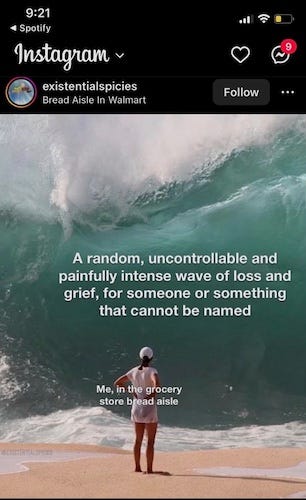
Recently, though, a friend shared a meme with me, and it really resonated. It’s a picture of a human (labeled “me, in the grocery store bread aisle”), staring at a huge, looming ocean wave in front of them. The wave is labeled “A random, uncontrollable and painfully intense wave of loss and grief, for someone or something that cannot be named.”
Let me share a bit about what it felt like to have this meme resonate.
- Laughter bubbled up inside of me that came from the surprise of having something articulated in a public space that I had never articulated to myself
- A cringe intermingled with the laughter as I was reminded of the pain I had felt in the grocery store just the other day.
- I suddenly felt very “zoomed out” and dazed while I tried to process what it means that I am not alone in this experience.
- Finally, I felt myself sigh deeply, and thought something along the lines of “What am I living through right now? What is this moment? How can I grapple with it?”
The powerful thing about memes is that they sum up a lot of complex feelings in a pithy, relatable way. This meme made me feel both confused and relieved that others must feel similarly. I wanted to unpack why this meme resonated with me. I wanted to learn what the resonance says about my worldview. And I hoped to come away with a better idea of what it says about what we’re living through, what this moment is, and what we might do about it.
The First Time I Ever Bought Laundry Detergent
The first time I remember feeling something like this, I was in a Target sometime early in college. It was my first time buying laundry detergent for myself, and I remember staring at the aisle of choices, and feeling tears well up in my eyes.
I think a few things were going on:
- I was dealing with the paradox of choice. (In other words, the concept that while some choice is good, too much choice can be paralyzing and overwhelming.)
- I was processing how ridiculous it was that there were so many options for laundry detergent. The paradox of choice for health insurance or where to live is frustrating. But at least those things have real implications. But laundry detergent?
- I felt a sense of freedom “woah, I can choose my own laundry detergent now. I should choose one that matches my personality.”
- And that was at tension with “Wait, no seriously. It doesn’t matter at all. Which one is cheapest? I can’t even tell because it would take too long to look at each label.”
- I was thinking “look at all this plastic which can’t actually be recycled because, for the most part, the idea that plastic is recyclable is a myth.”
- And there were many other things running through my head like, “I’m sad to be in this depressing building instead of outside in the sunshine.” “I’m stressed because I have an exam coming up.” “I’m hungry.” …
I don’t remember which laundry detergent I chose. And it still doesn’t matter. Now, like a good capitalist drone, I scan the aisle for the packaging that looks like it’s marketed to my demographic. It’s usually brown or clear packaging. It has no dyes in it. And then I can choose between lemon, lavender, or unscented.
But getting to that point required, eventually, just pinching my nose and holding my breath (often literally in the heavily scented laundry detergent aisle), and trudging through the system, trying to find the path of least resistance through it, and trying not to think about it.
These Days
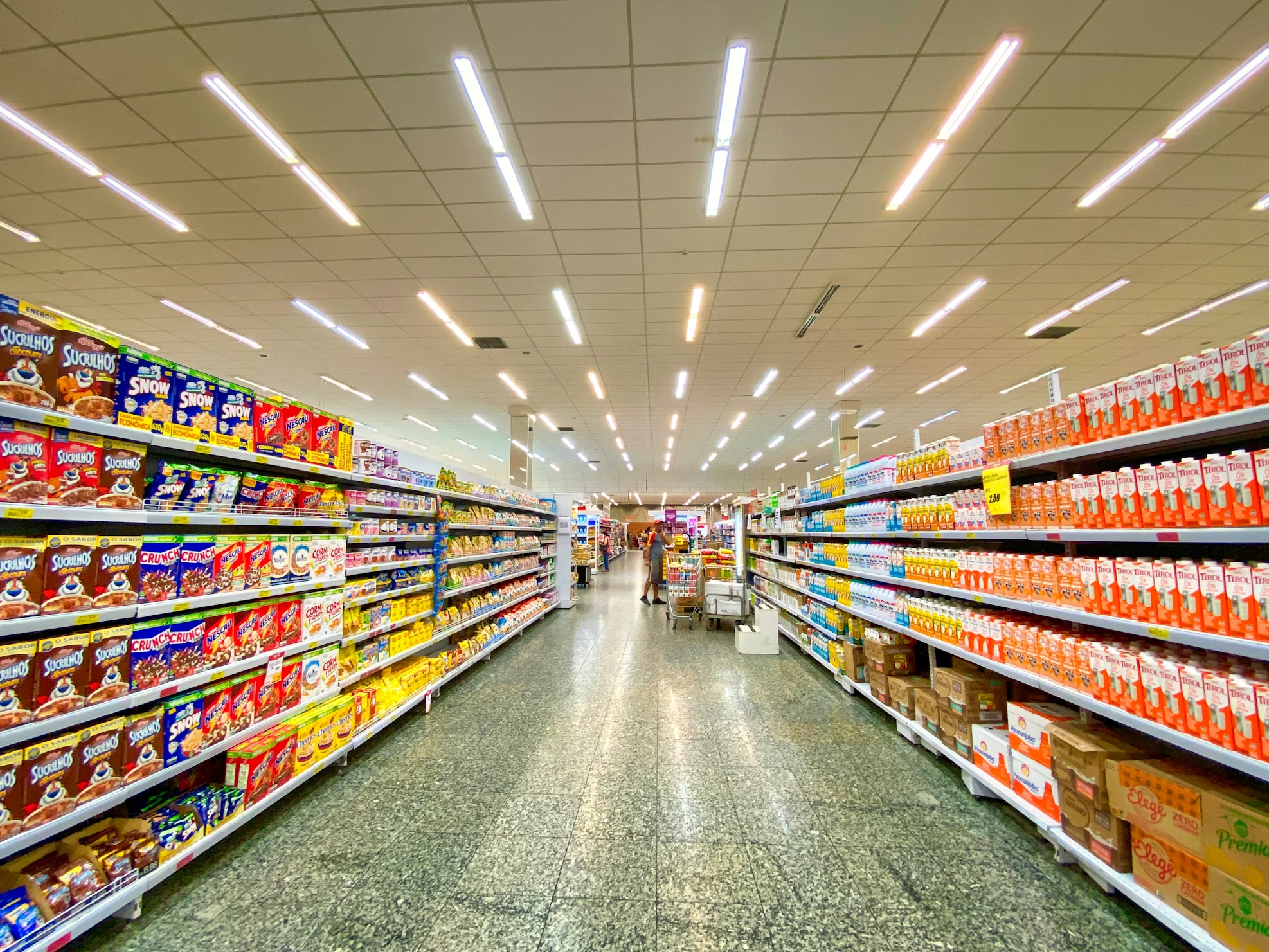
These days, I still feel overwhelmed in the grocery store. And it hits me in most aisles now.
I see the colorful packaging, each product designed to compete with the product next to it. Each glistening bag begging for your attention, anticipating your weakness (a.k.a. your human psychology). Each company behind the packaging begging: begging for your dollar, for your craving, for your acceptance, for your dependence.
When I pick out strawberries, I think of all the little strawberry plants (even the organic ones!) who spend their lives in an industrial row, on life support, until they can be plucked, packed in plastic, and shipped to me.
There is cheery music playing in the store. But the faces of the employees who are clearly exhausted and underpaid, and my own feelings of exhaustion and emptiness, are at odds with the upbeat soundtrack.
And when I leave the store, it’s really all the same. Every time I try to find something on YouTube, I’m first inundated with some product that wants my attention. When I pick up my phone to do anything, I’m promptly distracted by a variety of notifications, and I forget why I picked up my phone in the first place. I drive home, past the too-green grass that the city maintains, spraying gallons of water to keep the grass lush in the dry climate of Colorado, where the grass wants to die.
It’s all overwhelming, all set to the cheery soundtrack of “Hi, how are you?” “Good, how are you?” “Good.” “Great, have a good day!”
And too often, the strawberries that I buy just rot in the back of my fridge, making me feel responsible for the waste perpetually churned out by our civilization.
What the heck am I living through right now? What is this moment?
I’m really not deep in the theory, or academic research on this. Some people would just call what I’m experiencing “capitalism.” Others would probably bring in the term “late stage capitalism.” And once I start throwing around the word “capitalism,” some folks will pipe up to let me know that “socialism doesn’t work.” (Although, I don’t think anyone really knows what socialism means.)
Rather than trying to get a precise diagnosis here, I want to articulate a few observations.
1) You can buy almost anything.
- You want a disco-themed bra? That’ll be $17.03.
- You want a life-saving rabies vaccine series? Sure. An easy $1,200-$6,500. (Although your health insurance company may have different or no cost estimates for you. I know this tidbit from personal experience.)
- In some cases, you can even buy admission to your child’s college of choice
2) Building and/or finding community is really hard. My partner and I often feel isolated, even as COVID has become a less prominent driver in our lives. Many people I meet share that they, too, feel isolated. What does “home” mean? How do you find it?
3) We are surrounded by messaging that tells us we are insufficient and incomplete.
- When I find myself on Pinterest, TikTok, or Instagram, it’s less than 3 minutes before I’m told that my body is too big, too heavy, too soft, or too white (while other folks are told theirs is not white enough!).
- On LinkedIn, the message is that I am not achieving enough, growing enough, networking enough.
- Popular media tells me that my happily-ever-after is in a heterogeneous, cis, monogamous (probably white) relationship. In other words, if you don’t have a partner (and the right kind of partner, at that) you are incomplete, or have no place in society.
The feeling of being able to buy anything juxtaposed to a reality of isolation, impossible or undesirable metrics of success, and constant messaging of insufficiency is deeply troubling.
Maybe I will finally feel complete…
once I am hot enough, have accomplished enough, am loved enough.
So we feel we must buy more, grind more, be more.
And then we are exhausted, and lonely, and trying to pay rent and buy food and pay for health care. And we still feel incomplete.
What do we do about it?
Again, I’m really not here with theory and data. I’m here with personal experience and a hunch.
My partner recently signed me up for an improv comedy class, and my class just completed our “graduation showcase.” It was a night of laughs, camaraderie, support, and love. I felt fulfilled and not at all lonely. I felt proud. I felt courageous. I felt funny.
I was wearing a raggedy, DIY tie-dyed T-shirt and no makeup.
I felt complete.
I’m not here to suggest improv is the answer to our collective suffering. Far from it. But I think what improv forced me to do could be part of the answer.
Being up on that stage with my classmates, I had to lead with vulnerability, trust, humanity, and humility. I had to lean on other people when I was struggling, and I had to lift others up when they were struggling. I got to relish the applause from a supportive audience, even when I knew I could have been better, been funnier, done more. I got to appreciate their support and their love. They saw my humanity, and I felt theirs.
This is my best guess for how we can start to feel better. We have to divest from the places that make us feel incomplete, overwhelmed, and empty. We have to invest in the places, and most importantly, the people, which make us feel whole.